- →Zoho CRM's paid tiers start at $14/user/month, Salesforce starts at $25/user/month. A 100-user Zoho CRM Enterprise deployment runs about $48,000/year versus roughly $210,000/year for Salesforce Enterprise, before add-ons.
- →Zoho CRM wins on cost predictability, faster setup, and standard sales complexity. Salesforce wins on customization ceiling, marketplace depth, and highly complex multi-cloud governance.
- →The real mistake is picking either platform based on brand reputation instead of mapping your actual sales process first.
Choosing between Zoho CRM and Salesforce usually comes down to a feature table, a pricing chart, and a vague "it depends on your business." That doesn't help you decide.
We've delivered 550+ Zoho implementations over eight years as a Zoho specialist. That gives us direct, hands-on visibility into what actually happens once a project starts, what breaks during a migration off Salesforce, and where Salesforce genuinely is the better platform.
Most of that work is Zoho CRM consulting for teams migrating off Salesforce or deciding between the two platforms before they build anything.
Zoho CRM Versus Salesforce at a Glance
| Zoho CRM | Salesforce | |
| First paid tier | $14/user/month (Standard) | $25/user/month (Starter Suite) |
| Top traditional CRM tier | $52/user/month (Ultimate) | $350/user/month (Unlimited) |
| Highest listed tier overall | $52/user/month | $550/user/month (Agentforce 1 Sales) |
| Free plan | Up to 3 users | Up to 2 users (Free Suite) |
| Typical setup time | Days to a few weeks | Weeks to months, usually with outside help |
| Best for | Small to mid-market teams, cost-conscious buyers | Complex enterprise sales processes |
| Customization ceiling | Strong for standard processes | Very high, built for custom logic |
| Admin overhead | Lower, especially at mid-market scale | Higher, often needs a dedicated admin |
Swipe to see more →
Pricing: What Each Platform Actually Costs
List price is where most comparisons stop, and it's the least useful number in the decision.
Zoho CRM's four paid editions (annual billing):
- Standard: $14/user/month
- Professional: $23/user/month
- Enterprise: $40/user/month
- Ultimate: $52/user/month
Salesforce Sales Cloud's tiers (annual billing, except Starter):
- Starter Suite: $25/user/month, the first paid tier above the free plan
- Pro Suite: $100/user/month
- Enterprise: $175/user/month
- Unlimited: $350/user/month
- Agentforce 1 Sales: $550/user/month, the highest listed tier
These editions aren't directly equivalent feature-for-feature, so the plan names matter less than what each business actually needs.
A worked example, since vague TCO estimates aren't useful: a 100-user Salesforce Enterprise deployment runs $175 x 100 x 12 = $210,000 a year in license fees alone, before implementation, admin, integrations, or add-ons like Sales Engagement ($50/user/month) or Revenue Intelligence ($220/user/month). A 100-user Zoho CRM Enterprise subscription runs $40 x 100 x 12 = $48,000 a year. These are not equivalent product configurations, so treat the gap as directional rather than a like-for-like swap. Zoho has a lower published per-user price across the paid editions commonly considered by small and mid-market buyers, though features and usage limits differ between plans.
What Zoho CRM Implementation Actually Looks Like
Across 550+ Zoho CRM implementation projects, one pattern holds consistently: the software is rarely what determines speed. How clearly the business has mapped its own sales process before configuration starts does.
What stalls a project:
- Implementation begins before the sales process is documented
- Fields get added reactively
- Workflows get built around assumptions instead of the real process
- Six months later, the system works, but nobody can explain why it's built the way it is
If that pattern sounds familiar, the fix usually isn't starting over. We've mapped the five root causes of a failed Zoho CRM implementation and the four recovery paths that don't require a rebuild.
What keeps a project on track:
- A short discovery phase that documents the current process first
- Costs a few extra days upfront, saves months of rework later
What actually drives cost and timeline:
- Number of users
- Number of integrations (accounting software, marketing tools, custom apps)
- How much of the sales process needs custom logic versus what Zoho covers natively
For a concrete example, see how we automated a client's full inquiry-to-contract sales and operations workflow inside Zoho.


Migrating From Salesforce to Zoho: What's Actually Involved
Businesses moving from Salesforce to Zoho usually aren't unhappy with CRM as a category. They're unhappy with cost, complexity, or low adoption on a platform their team never fully embraced.
Three things consistently matter:
- Data mapping. Salesforce's object model doesn't map one-to-one onto Zoho's structure. Custom objects, complex relationship fields, and years of accumulated legacy data all need a deliberate mapping plan before a single record moves. The most common preventable risk is incomplete or incorrect data mapping, whether that shows up as omitted attachments, unsupported history, relationship errors, field-length mismatches, or failed records hitting API limits. A safe migration includes backups, a test migration pass, a failed-record review, record-count reconciliation, and user acceptance testing before cutover.
- Workflow rebuilding. Automations built in Salesforce Flow don't transfer. They need to be rebuilt in Zoho's workflow and Blueprint tools, usually a good chance to simplify logic that had grown more complicated than it needed to be.
- Adoption. A team that resisted Salesforce because it felt heavy won't automatically embrace Zoho just because it's simpler. Training and a clear rollout plan still matter, especially for a team that's already been through one CRM change.
For a breakdown of Salesforce's per-cloud pricing, the technical debt that builds up in long-running orgs, and Evoluz's field-mapping and FRD/TRD migration methodology, see our full Salesforce Alternatives guide.
Zoho CRM vs Salesforce: AI Capabilities
No 2026 comparison is complete without this. Zoho's Zia and Salesforce's Agentforce are the two platforms' AI layers, and they're built on different bets.
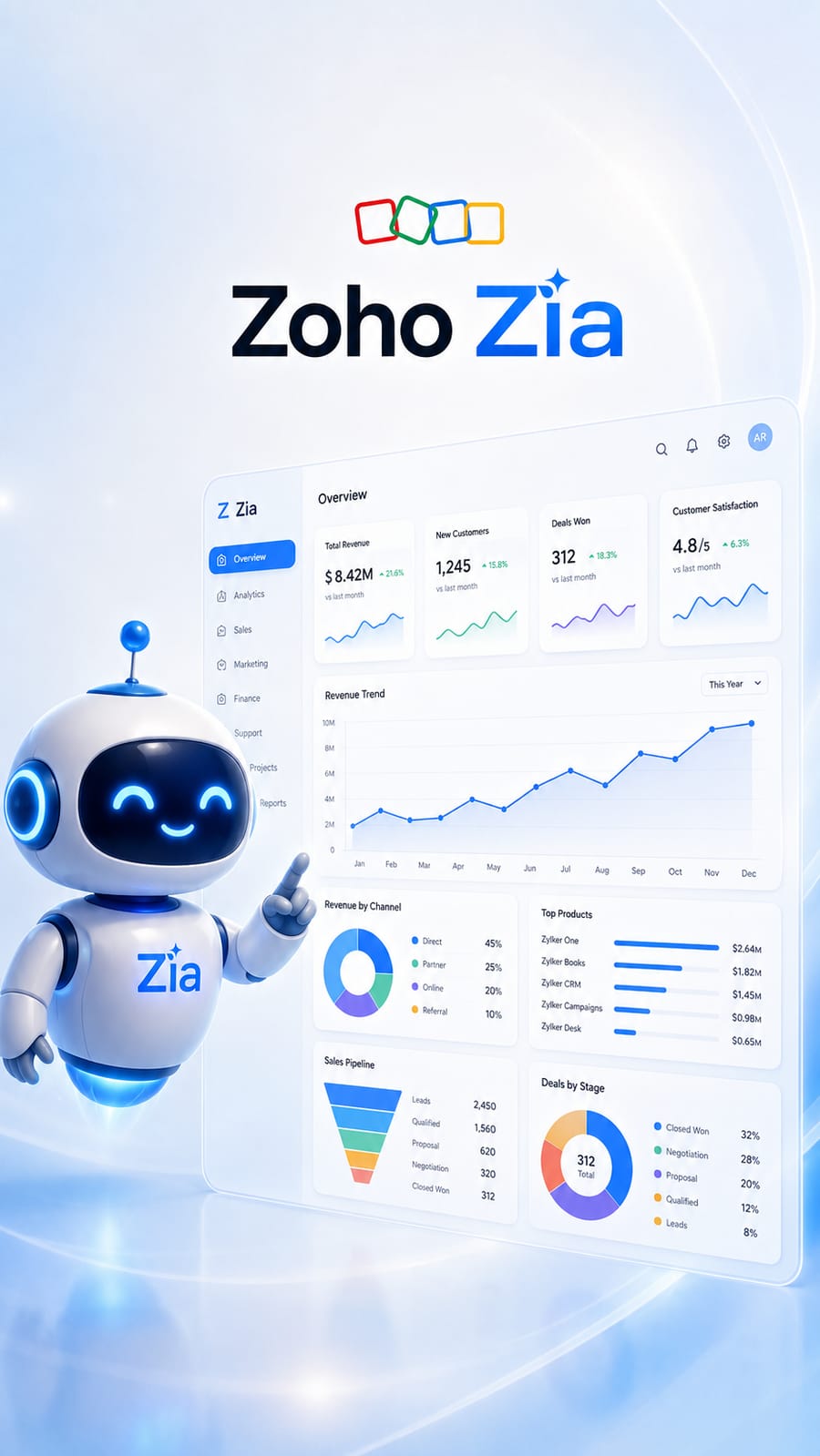
Zia (Zoho):
- Predictive lead and deal scoring, churn prediction, forecasting, and generative email drafting, plus Zia Agents for autonomous task execution across 60+ Zoho apps
- Many Zia capabilities are included within Zoho CRM Enterprise and Ultimate, although feature availability, usage limits, and user-count requirements vary
- Runs on Zoho's own hosted LLMs with regional data residency options, relevant if GDPR or India data-residency rules apply
- Predictive features require enough clean, consistently recorded historical activity to identify meaningful patterns. The amount of data needed varies by feature, sales cycle, and data quality
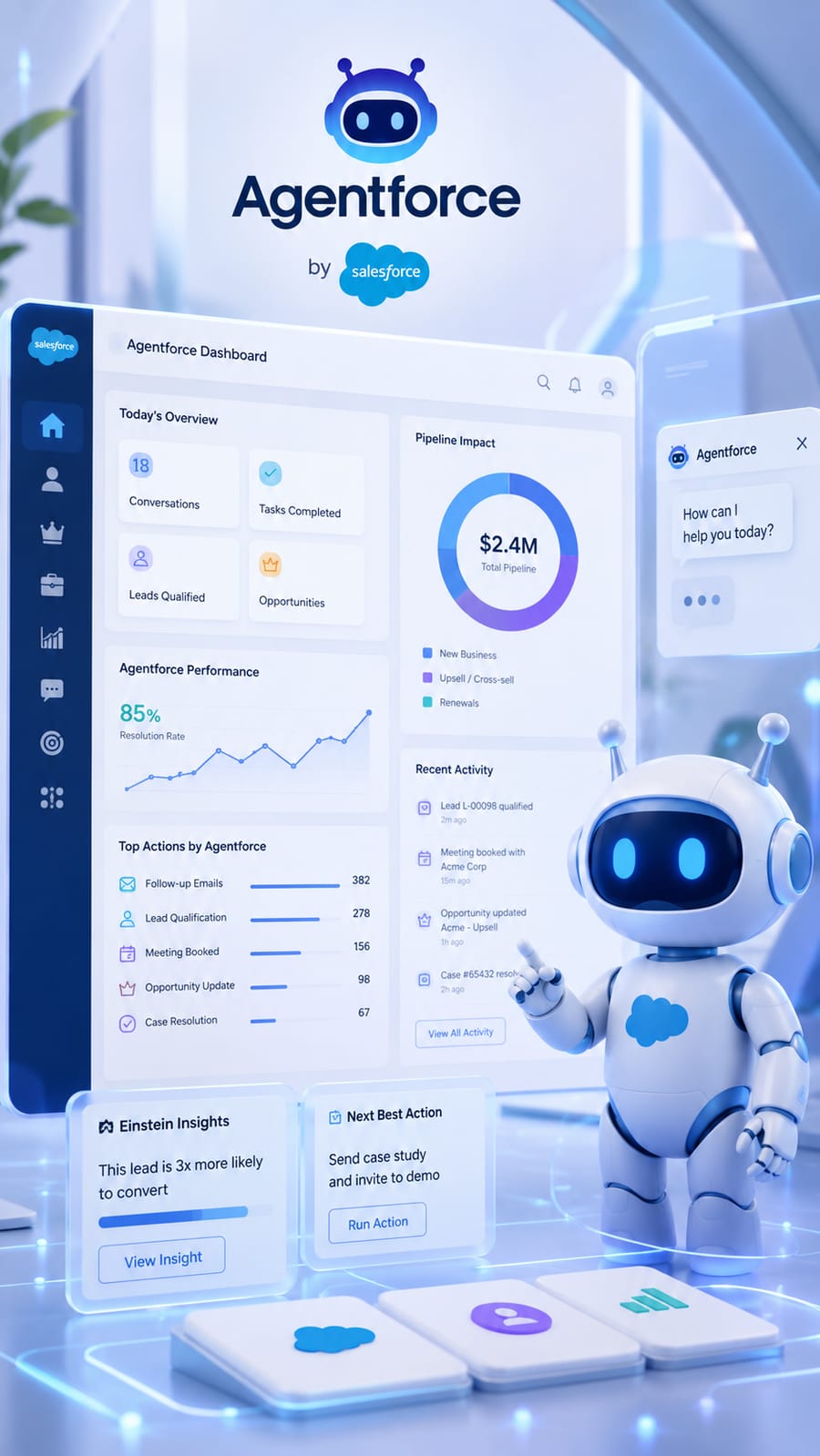
Agentforce (Salesforce):
- Predictive and generative AI (Einstein) plus autonomous agents that can execute full workflows, positioned as Salesforce's primary AI strategy
- Available as an add-on on Enterprise and Unlimited using a usage-based Flex Credits model, or as part of Agentforce 1 Sales at $550/user/month, including unmetered employee Agentforce usage for licensed users, alongside an annual allocation of Flex Credits for metered use cases
- Pricing has changed structure multiple times since its 2024 launch, so budget for the credit model to keep evolving
- Better suited to highly customized AI use cases when the organization already relies on Salesforce Flow, Apex, Data Cloud, industry clouds, and complex permission structures
The question that matters more than either feature list: does your CRM data support AI yet? Predictive scoring and forecasting depend on clean, consistent historical data. A business with scattered records, duplicate leads, and inconsistent stage tracking won't get meaningful value from either Zia or Agentforce until that data problem is fixed first, regardless of which platform it's running on.

Where Each CRM Genuinely Wins
Zoho CRM wins on:
- Cost predictability at scale, especially once you compare tiered CRM pricing against Zoho One's all-employee pricing model
- Faster setup for teams without a dedicated IT function
- Broad omnichannel coverage through Zoho CRM and connected Zoho applications, including email, social media, telephony, meetings, and live chat, though some channels require separate Zoho products, telephony providers, or licenses
- Standard sales complexity without heavy configuration overhead
Salesforce wins on:
- Customization ceiling: Apex and Flow Builder go far beyond any out-of-the-box CRM
- Marketplace depth: AgentExchange unifies Salesforce's traditional app marketplace, Slack integrations, and the Agentforce agent ecosystem into one destination, with over 12,000 apps and integrations and more than 1,000 agents and skills
- Strict governance, multi-cloud operations, or sales processes too complex for standard automation
Zoho CRM Versus Salesforce: Which One Fits Your Business?
| Business profile | Better fit |
| Small team, straightforward sales process, tight budget | Zoho CRM |
| Growing mid-market team, standard-to-moderate complexity | Zoho CRM |
| Mid-market team with heavily customized sales logic | Depends on the logic, worth a discovery call |
| Enterprise with multi-cloud operations, highly customized governance, or specialized regulatory architecture | Salesforce may be the stronger fit after a formal compliance assessment |
| Already on Salesforce, high adoption, few complaints | Stay on Salesforce |
Compliance alone shouldn't decide this. Zoho also supports regulated organizations with substantial security programs, and the right answer depends on the specific regulation, data location, audit model, and integration architecture, not the platform's general reputation.
The businesses that regret their choice are almost always the ones that picked based on brand reputation rather than their actual sales process.
Why the Implementation Partner Matters as Much as the Platform
Two businesses can run the same CRM and get completely different results. The difference usually comes down to whether the implementation was built around how the business actually sells, or around a generic template.
We've stayed Zoho-only rather than positioning as a multi-platform shop, because depth on one platform, across 550+ implementations, produces better outcomes than shallow coverage across several. Every engagement starts with a documented current-state and future-state sales process map, a functional requirements document (FRD), and a technical requirements document (TRD), before a single field gets configured. That sequence is what prevents the six-month rebuild.
The same discipline applies regardless of company size — see how it plays out for smaller teams in why small businesses need expert guidance to build scalable Zoho CRM systems.
If a tight budget and a single, straightforward sales process describe your business, start with Zoho CRM consulting for small business rather than a platform built for enterprise complexity you don't have yet.
Market Perception: Salesforce's Edge, in Context
Salesforce Sales Cloud holds a 4.4 out of 5 rating on G2 across more than 24,000 reviews. Zoho CRM holds a 4.1 out of 5 rating on the same platform. A few things worth knowing about that gap:
- Zoho holds a narrower but real advantage in ease of use, ease of setup, and ease of administration
- Salesforce scores higher on quality of support, lead management, and integration depth
- The review populations differ considerably. Salesforce draws a much larger share of enterprise and mid-market reviews, which shapes what gets rated well
That context matters more than the headline number. A platform optimized for large, complex deployments will naturally score differently than one optimized for fast, self-serve setup, and the "better" platform depends on which of those two problems your business actually has.
Final Verdict
- Standard-to-moderate sales complexity, cost predictability matters: Zoho CRM is the stronger choice for most small and mid-market businesses
- Multi-cloud enterprise operations, specialized regulatory needs, deep custom logic: Salesforce's ceiling can justify its cost, but confirm that with a real compliance assessment rather than assuming it
The real mistake is picking either platform without mapping your actual sales process first.
Not sure which one fits your business? Book a free architecture audit if you're starting fresh with Zoho, or a free migration assessment if you're evaluating a move off Salesforce.
Book a Free Architecture Audit